pastclim, an R package to easily access and use palaeoclimatic data

It is now out in bioRxiv a new preprint describing pastclim, an R package facilitating the access and the use of palaeoclimatic data, that I co-developed.

Michela Leonardi, Emily Y. Hallett, Robert Beyer, Mario Krapp, Andrea Manica
pastclim: an R package to easily access and use paleoclimatic reconstructions
bioRxiv 2022.05.18.492456; doi: https://doi.org/10.1101/2022.05.18.492456
Recently, the development of continuous palaeoclimatic reconstructions covering hundreds of thousands of years has made it possible to integrate the climate in the past into studies of many different disciplines: from paleoecology to linguistics, from archaeology to conservation biology, and from population genetics to human evolution.

Unfortunately, however, climate data can be difficult to extract and analyze for scholars unfamiliar with the specific formats in which it is shared. Together with my colleagues from Cambridge and Jena, we addressed this problem by creating pastclim: an R package that facilitates the access and use of two sets of paleoclimate reconstructions covering the last 120,000 and 800,000 years, respectively.

The package contains a set of functions that allow you to quickly and easily recover the climate of specific areas for periods of interest, extract climatic data of points scattered in space and/or time, recover historical series from single sites and easily manage perennial ice and coastlines.

The preprint contains two examples (the code in R and associated data can be downloaded from here). In the first one, we show how to extract the climate reconstructions for a single archaeological site with dated stratigraphic layers, i.e., in one location for multiple time slices. In the second one, we show how to analyse a larger number of sites with lower individual coverage, i.e., a number of points scattered in space and time.

More info:

website: https://evolecolgroup.github.io/pastclim/index.html
github: https://github.com/EvolEcolGroup/pastclim
vignette: https://evolecolgroup.github.io/pastclim/articles/a0_pastclim_overview.html

pastclim is not on CRAN.

[update 16/01/2023: pastclim is now on CRAN ]

Preprint

Michela Leonardi, Emily Y. Hallett, Robert Beyer, Mario Krapp, Andrea Manica
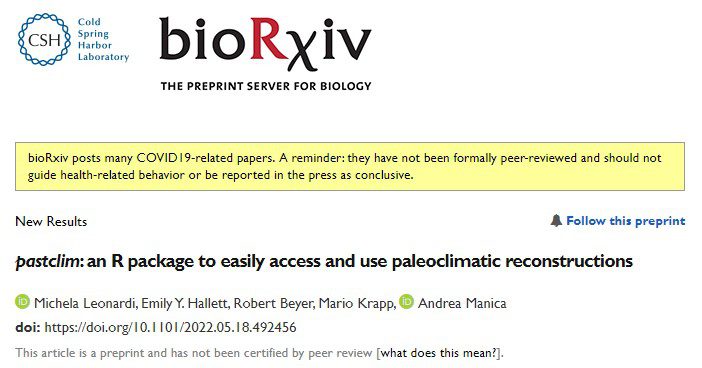
pastclim: an R package to easily access and use paleoclimatic reconstructions
bioRxiv 2022.05.18.492456; doi: https://doi.org/10.1101/2022.05.18.492456
Abstract

The recent development of continuous paleoclimatic reconstructions covering hundreds of thousands of years paved the way to a large number of studies from disciplines ranging from paleoecology to linguistics, from archaeology to conservation and from population genetics to human evolution. Unfortunately, such climatic data can be challenging to extract and analyze for scholars unfamiliar with such specific climatic file formats.

Here we present pastclim, an R package facilitating the access and use of two sets of paleoclimatic reconstructions covering respectively the last 120,000 and 800,000 years. The package contains a set of functions allowing to quickly and easily recover the climate for the whole world or specific areas for time periods of interest, extract data from locations scattered in space and/or time, retrieve time series from individual sites, and easily manage the ice or land coverage.

The package can easily be adapted to paleoclimatic reconstructions different from the ones already included, offering a handy platform to include the climate of the past into existing analyses and pipelines.

Seminar for the Palaeolithic Archaeology module, La Sapienza University of Rome

Enza Spinapolice invited me to contribute a seminar to the Module “Palaeolithic archaeology” (MSc/MA level) at “La Sapienza” University of Rome.

I gave a talk entitled “La ricetta dell’interdisciplinarietà” (The recipe for interdisciplinarity), and it was followed by a long and lively discussion. Thank you Enza for giving me this exciting opportunity!

Genetic demography: What does it mean and how to interpret it

A new book chapter that I wrote just came out:

Leonardi, M., G. Barbujani, and A. Manica. 2021
Genetic demography: What does it mean and how to interpret it, with a case study on the Neolithic transition
In Ancient Connections in Eurasia, ed. by H. Reyes-Centeno and K. Harvati, pp. 91-100. Tübingen: Kerns Verlag. ISBN: 978-3-935751-37-7. https://doi.org/10.51315/9783935751377.005

Abstract

The present work describes the basic principles underlying demographic reconstructions from genetic data, and reviews the studies using such methods with respect to the Neolithic Demographic Transition. It is intended as a tool for scholars outside the field of population genetics (e.g., archaeologists, anthropologists, etc.) to better understand the significance and intrinsic limitations of genetic demography, and to help integrate its results within the broader context of the reconstruction of the human past.

Talk for the Evolutionary Anthropology Seminar Series, University College London

Yesterday I had the honour and the pleasure to give a talk at the Department of Anthropology at UCL, within the Evolutionary Anthropology Seminar Series.

The title of my presentation was “How to integrate Anthropology in (academic) careers within other disciplines”, and it sparked a lively discussion where we covered a lot of topics from career choices to grant opportunities, and much more.

Thank you, Mark Dyble, for inviting me!

New project on Neanderthal palaeoecology

I am very honoured to announce that, starting from tomorrow, I will be working on a new Leverhulme-funded Research Project as the nominated researcher.

The project is called “Neanderthal Palaeoecology: the whens, hows, and whys of a species’ journey“, I co-wrote it together with my PI, prof. Andrea Manica, and it involves the collaboration with internationally renowned scholars (see the list at the end of the post).

Description

The following text is an extract of the article we wrote for the 2021 February’s Newsletter of the Leverhulme Trust (cover and page 16).

Neanderthals (Homo neanderthalensis) are a human species that lived in western Eurasia between approximately 350,000 and 30,000 years ago. Since the discovery of the first fossil in 1856, a huge body of research from multiple disciplines has helped us uncover more and more about this species.

Genetic analysis of DNA from fossil remains from multiple locations and periods has revealed a major population replacement between 90 and 120 thousand years ago in central Asia. Unfortunately, genetic data, which are very powerful at detecting change, cannot inform us of the processes behind such population dynamics. Climate is an obvious candidate in explaining this population turnover, but formally demonstrating its role is not easy.

We gathered an interdisciplinary team composed of archaeologists, ecologists, paleoclimate modellers and cultural evolution specialists. Together, we will investigate the role of climate in shaping the population dynamics of Neanderthals over their whole temporal and geographic range. We will also incorporate cultural information to see if and how different Neanderthal populations changed and adapted their behaviour in response to climatic fluctuations. 

By doing so, we will be able to put the population turnover that occurred 120 thousand years ago into context, providing a clear test of whether climatic changes are a likely explanation. But most importantly, for the first time, we will be able to test for the role of climate in the whole species’ journey of Neanderthals, integrating cultural evolution into the big picture, to better understand the whens, hows, and whys of the journey of this fascinating human species.

Stay tuned for exciting news and research outputs!

Collaborators

The project will be in collaboration with the following scholars (the order is the same in which they joined the project).

  • Prof. Katerina Harvati, University of Tuebingen;
  • Prof. Francesco D’Errico, University of Bordeaux;
  • Dr William E. Banks, University of Bordeaux;
  • Dr Judith Beier, University of Tuebingen;
  • Dr Philip Nigst, University of Vienna;
  • Dr Andrew Kandel, University of Tuebingen.
  • Zara Kanaeva, University of Tuebingen.