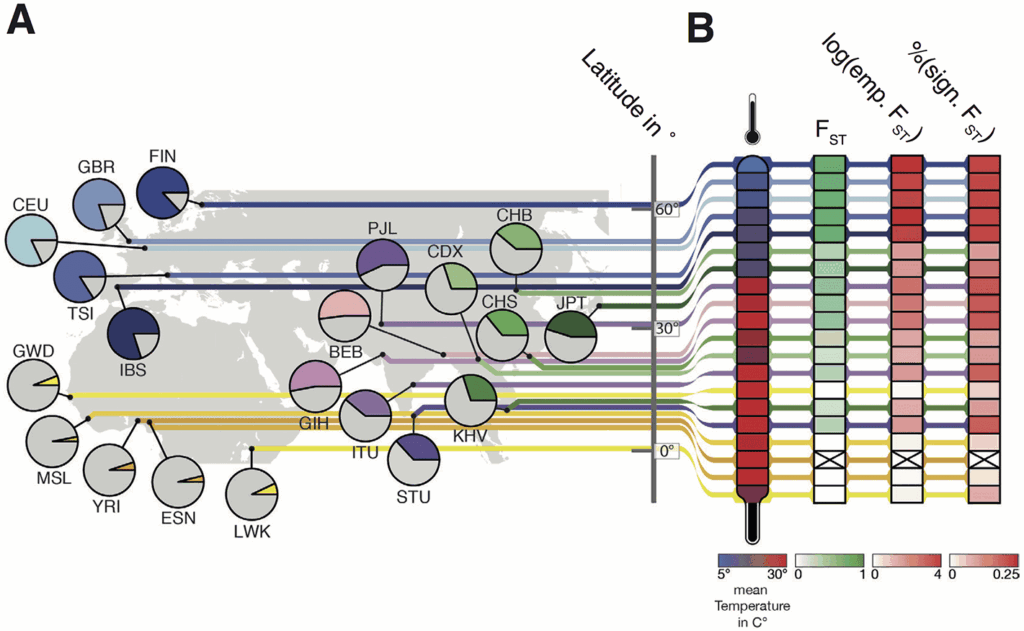
Figure 1 from Key et al 2018, showing the populations analysed, their allele frequencies for the variant associated with migraine (in colour), the average temperature, and FST signatures.
It just came out in Headache our commentary “Did Going North Give Us Migraine? An Evolutionary Approach on Understanding Latitudinal Differences in Migraine Epidemiology”. We discuss a recent publication (Key et al. 2018, Human local adaptation of the TRPM8 cold receptor along a latitudinal cline, PLoS Genet, 14 (5), e1007298) reconstructing the evolutionary history of a genetic polymorphism strongly associated with migraine. We collaborated with Alessandro Viganò and Vittorio di Piero, two medical doctors from the Sapienza University of Rome, to offer to the medical community a commentary piece on the importance of integrating an evolutionary approach into epidemiological studies of migraine, and other potentially genetic-associated diseases.
Alessandro Viganò, Andrea Manica, Vittorio Di Piero, Michela Leonardi
Did Going North Give Us Migraine? An Evolutionary Approach on Understanding Latitudinal Differences in Migraine Epidemiology
This commentary discusses a recent publication by evolutionary biologists with strong implications for migraine experts. The Authors showed that a gene polymorphism associated with migraine gave our ancestors an evolutionary advantage when colonizing northern, and thus colder, territories. They then highlight that the prevalence of migraine may differ among countries because of climatic adaptation. These results may prove useful in planning both epidemiological and physiological studies in the field of migraine.
Today I will be off to Dullingham (Newmarket) to take part in the Science Week organised by Kettlefield Primary School.
I will be co-responsible for the session “Guess the skull”, thanks to the Zoology Museum, University of Cambridge, who lent us their materials. We will be looking at the skulls of different animals, trying to guess who they are, what they eat, and learning a lot of other cool information about them.
I hope the children will have fun, I am sure I will!
If you are coming to the Cambridge University Botanic Garden tomorrow for Twilights at the Museum, you will find me there! I will volunteer for the visitor experience (i.e. handling maps, providing information, showing paths, and proposing activities).
Visitors will have the opportunity to see the Botanical Garden at night, beautifully lighten up for the occasion. They will also be able to follow a trail that will help them discover beautiful and endangered plants from all over the world, and how the scientific community is trying to protect them.
North-Western Tuscany (roughly Lucca and Massa Carrara provinces) has always been a corridor of exchange between Central and North-Western Italy. The region was disputed between the Etruscans and Ligurians, it has been then conquered by the Romans, and in the following centuries underwent several changes of rulers.
We tried to define if and when such complex history entailed matrilinear discontinuity in the local population. We did so by analysing a portion of the mitochondrial DNA in 119 samples from the region, dated from the Copper age (around 5,000 years ago) the Roman period, the Renaissance, modern-day and including some Etruscan sequences from the whole of Tuscany.
Using computer simulations we found out that the better explanation for the genetic diversity in our samples is that they belong to the same population, in continuity through time. This is a quite surprising result since similar degrees of long-term continuity have been mostly observed in isolated areas.
A possible explanation of those results is that either the historical changes observed in north-western Tuscany (conquers, immigration etc.) mainly lead to foreign males arriving and marrying local females. It is also possible that the rulers from outside (Romans, Lombards, French) and the local population did not mix significantly because they were part of different social groups. Whatever the region may be, modern-day Lucca inhabitants appear to be the direct descendants of the women living in the regions millennia ago, teaching us that genetic continuity can not only be found in isolated communities.
Michela Leonardi, Anna Sandionigi, Annalisa Conzato, Stefania Vai, Martina Lari, Francesca Tassi, Silvia Ghirotto, David Caramelli, Guido Barbujani
The female ancestor’s tale: Long‐term matrilineal continuity in a nonisolated region of Tuscany
Objectives: With the advent of ancient DNA analyses, it has been possible to disentangle the contribution of ancient populations to the genetic pool of the modern inhabitants of many regions. Reconstructing the maternal ancestry has often highlighted genetic continuity over several millennia, but almost always in isolated areas. Here we analyze North‐western Tuscany, a region that was a corridor of exchanges between Central Italy and the Western Mediterranean coast.
Materials and methods: We newly obtained mitochondrial HVRI sequences from 28 individuals, and after gathering published data, we collected genetic information for 119 individuals from the region. Those span five periods during the last 5,000 years: Prehistory, Etruscan age, Roman age, Renaissance, and Present‐day. We used serial coalescent simulations in an approximate Bayesian computation framework to test for continuity between the mentioned groups.
Results: Our analyses always favor continuity over discontinuity for all groups considered, with the Etruscans being part of the genealogy. Moreover, the posterior distributions of the parameters support very small female effective population sizes.
Conclusions: The observed signals of long‐term genetic continuity and isolation are in contrast with the history of the region, conquered several times (Etruscans, Romans, Lombards, and French). While the Etruscans appear as a local population, intermediate between the prehistoric and the other samples, we suggest that the other conquerors—arriving from far—had a consistent social or sex bias, hence only marginally affecting the maternal lineages. At the same time, our results show that long‐term genealogical continuity is not necessarily linked to geographical isolation.
Horses in Camargue, France. Photo by Michela Leonardi
It just came out in Science Advances our paper “Late Quaternary horses in Eurasia in the face of climate and vegetation change“, done in collaboration with Ludovic Orlando (Copenhagen/Toulouse), David Nogues-Bravo (Copenhagen), Andrea Manica (Cambridge), Francesco Boschin and Paolo Boscato (Siena), and many other excellent scientists!
This study represents the most ambitious effort so far to reconstruct the palaeoecology of the horse in Eurasia through more than 40 thousand years to gain a better understanding of their population dynamics through space and time. Our results suggest that European and Asian horses show different climatic adaptations; allow a better understanding of the progressive reduction in European horse remains during the Holocene, and shed new light on potential domestication centres.
Michela Leonardi, Francesco Boschin, Konstantinos Giampoudakis, Robert M. Beyer, Mario Krapp, Robin Bendrey, Robert Sommer, Paolo Boscato, Andrea Manica, David Nogues-Bravo and Ludovic Orlando
Late Quaternary horses in Eurasia in the face of climate and vegetation change
Wild horses thrived across Eurasia until the Last Glacial Maximum to collapse after the beginning of the Holocene. The interplay of climate change, species adaptability to different environments, and human domestication in horse history is still lacking coherent continental-scale analysis integrating different lines of evidence. We assembled temporal and geographical information on 3070 horse occurrences across Eurasia, frequency data for 1120 archeological layers in Europe, and matched them to paleoclimatic and paleoenvironmental simulations for the Late Quaternary. Climate controlled the distribution of horses, and they inhabited regions in Europe and Asia with different climates and ecosystem productivity, suggesting plasticity to populate different environments. Their decline in Europe during the Holocene appears associated with an increasing loss and fragmentation of open habitats. Europe was the most likely source for the spread of horses toward more temperate regions, and we propose both Iberia and central Asia as potential centers of domestication.