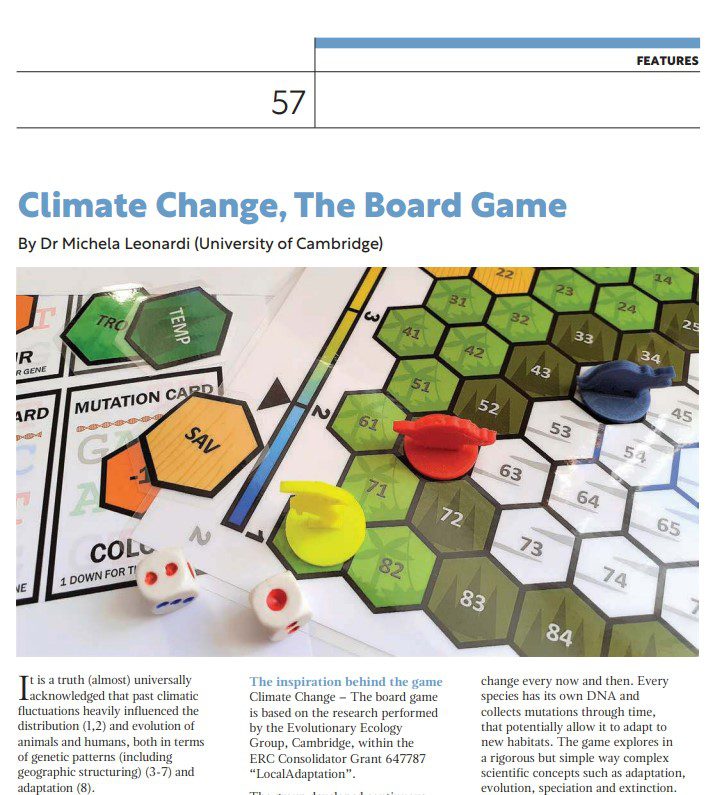
Yesterday I had the pleasure of taking part to the Webinar “Women in climate change – Donne e cambiamento climatico”, part of the campaign organised by Wikimedia Foundation Sustainability Consortia to increase the visibility of women that are playing a crucial role in climate change.
You can find below the video of the whole event (in Italian), my talk starts at the 28th minute.
I am very honoured to announce that, starting from tomorrow, I will be working on a new Leverhulme-funded Research Project as the nominated researcher.
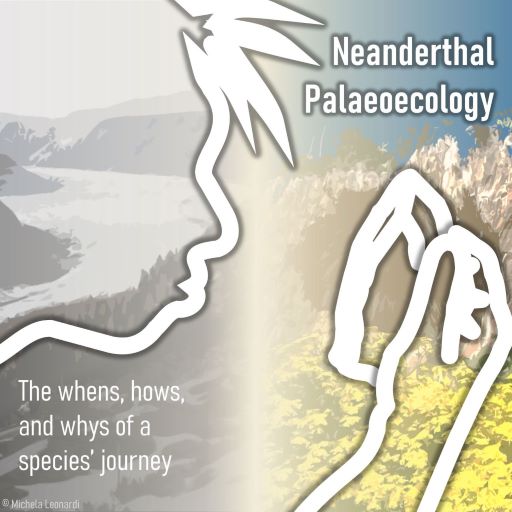
The project is called “Neanderthal Palaeoecology: the whens, hows, and whys of a species’ journey“, I co-wrote it together with my PI, prof. Andrea Manica, and it involves the collaboration with internationally renowned scholars (see the list at the end of the post).
Description
The following text is an extract of the article we wrote for the 2021 February’s Newsletter of the Leverhulme Trust (cover and page 16).
Neanderthals (Homo neanderthalensis) are a human species that lived in western Eurasia between approximately 350,000 and 30,000 years ago. Since the discovery of the first fossil in 1856, a huge body of research from multiple disciplines has helped us uncover more and more about this species.
Genetic analysis of DNA from fossil remains from multiple locations and periods has revealed a major population replacement between 90 and 120 thousand years ago in central Asia. Unfortunately, genetic data, which are very powerful at detecting change, cannot inform us of the processes behind such population dynamics. Climate is an obvious candidate in explaining this population turnover, but formally demonstrating its role is not easy.
We gathered an interdisciplinary team composed of archaeologists, ecologists, paleoclimate modellers and cultural evolution specialists. Together, we will investigate the role of climate in shaping the population dynamics of Neanderthals over their whole temporal and geographic range. We will also incorporate cultural information to see if and how different Neanderthal populations changed and adapted their behaviour in response to climatic fluctuations.
By doing so, we will be able to put the population turnover that occurred 120 thousand years ago into context, providing a clear test of whether climatic changes are a likely explanation. But most importantly, for the first time, we will be able to test for the role of climate in the whole species’ journey of Neanderthals, integrating cultural evolution into the big picture, to better understand the whens, hows, and whys of the journey of this fascinating human species.
Stay tuned for exciting news and research outputs!
Collaborators
The project will be in collaboration with the following scholars (the order is the same in which they joined the project).
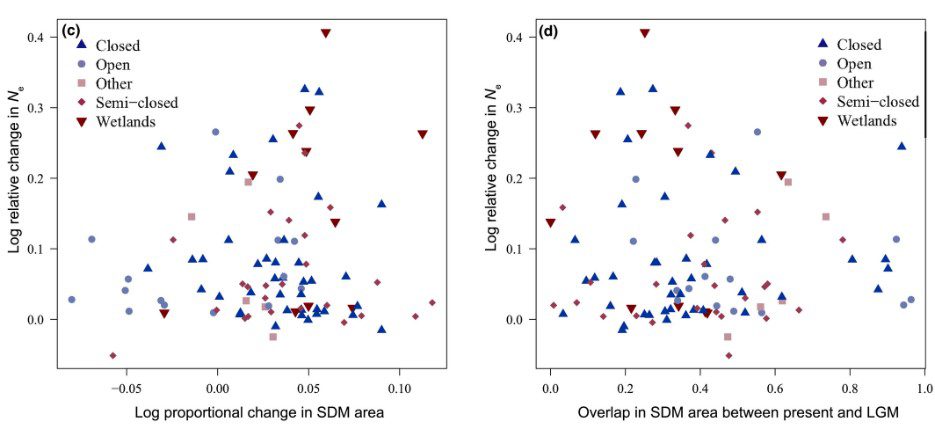
We analysed more than 100 species of Holarctic birds finding that genetics and ecology do not agree in reconstructing how more they reacted to past climatic fluctuations.
Why should we care? The reconstructions compared in our paper (one based on genetic data, the other on ecological modelling) are widely used to assess how well species can react to the ongoing climate emergency.
In our study, we show that when we systematically compare them for a lot of species they tend to tell us quite different stories. This does not mean that they are wrong: different methods are based on different assumptions, and each of them is likely to be missing a small but significant part of the whole story.
So, when we use these methods, the key is interdisciplinarity: integrating into the analyses different lines of evidence help tackle these limitations and get more reliable results.
During the Quaternary, large climate oscillations impacted the distribution and demography of species globally. Two approaches have played a major role in reconstructing changes through time: Bayesian Skyline Plots (BSPs), which reconstruct population fluctuations based on genetic data, and Species Distribution Models (SDMs), which allow us to back-cast the range occupied by a species based on its climatic preferences. In this paper, we contrast these two approaches by applying them to a large data set of 102 Holarctic bird species, for which both mitochondrial DNA sequences and distribution maps are available, to reconstruct their dynamics since the Last Glacial Maximum (LGM). Most species experienced an increase in effective population size (Ne, as estimated by BSPs) as well as an increase in geographical range (as reconstructed by SDMs) since the LGM; however, we found no correlation between the magnitude of changes in Ne and range size. The only clear signal we could detect was a later and greater increase in Ne for wetland birds compared to species that live in other habitats, a probable consequence of a delayed and more extensive increase in the extent of this habitat type after the LGM. The lack of correlation between SDM and BSP reconstructions could not be reconciled even when range shifts were considered. We suggest that this pattern might be linked to changes in population densities, which can be independent of range changes, and caution that interpreting either SDMs or BSPs independently is problematic and potentially misleading.
Yesterday I had the pleasure to host the Pint of Science Cambridge event “Climate change and conservation after COVID-19: what’s next?”, an online roundtable with the geographer Chris Sandbrook, geoengineer Hugh Hunt, and Eleanor Bladon, zoologist and broadcaster.
It was a lively debate in which we discussed a lot of questions. What is happening with climate change and conservation? What are the next steps to be taken? Has the COVID-19 pandemic disrupted our efforts towards a greener world? How can technology help us? Look at the video below to find the answers proposed by our experts.