It is now out in the blog of the journal Ecography, a post that I have written about pastclim, our R package facilitating the access and use of palaeoclimatic data. You can read it at this link.
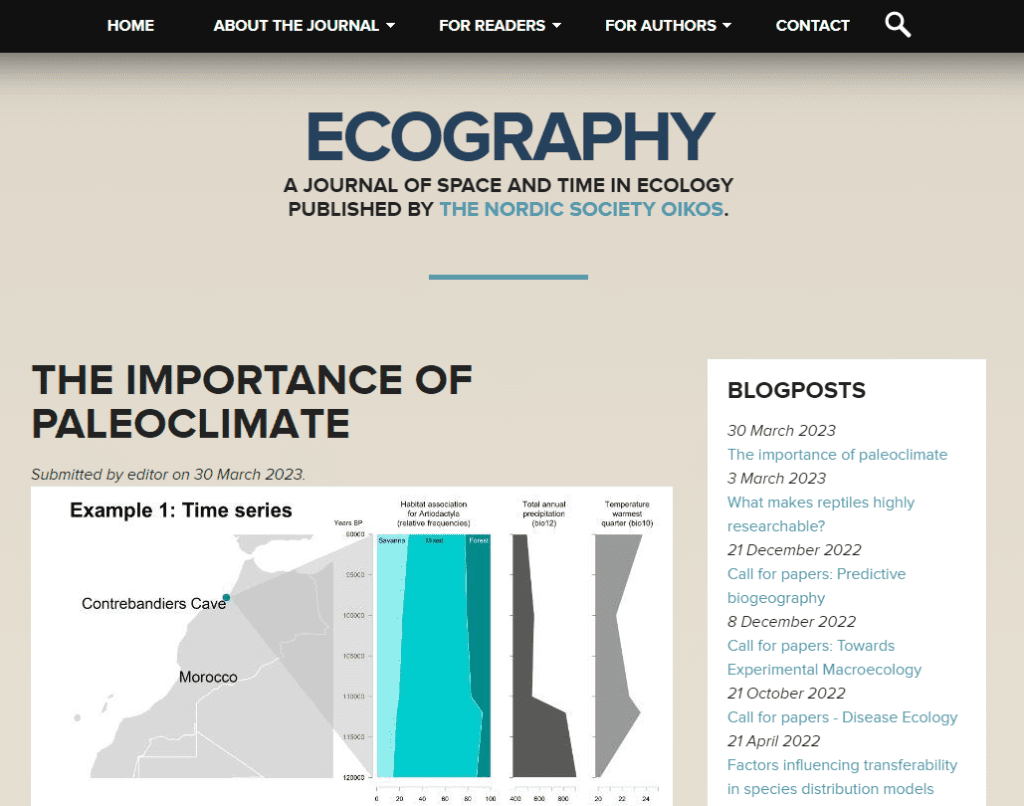
It is now out in the blog of the journal Ecography, a post that I have written about pastclim, our R package facilitating the access and use of palaeoclimatic data. You can read it at this link.
During the last couple of weeks, I have been asked by Matthew Collins (Department of Archaeology, University of Cambridge) to contribute two lectures to the module “Ancient Biomolecules”.
In my lecture “Climate and population genetics” I have discussed how to integrate climate into population genetics and genomics, which are the assumptions to take into account, and how to interpret the resulting information. In “The genetics of horse domestication”, I presented and explained a recent paper (Librado et al 2021, Nature) detailing the domestication and spread of Eurasian horses on the basis of ancient DNA data.


It was a lovely occasion, as my talks were followed by many questions and an interesting discussion. I hope there will be other opportunities to collaborate on these topics.

pastclim, our R package to easily access and use paleoclimatic reconstructions has now been updated to version 1.2. Moreover, is now out in Ecography the paper describing it:
Michela Leonardi, Emily Y. Hallett, Robert Beyer, Mario Krapp, Andrea Manica
pastclim 1.2: an R package to easily access and use paleoclimatic reconstructions
Ecography, First published: 05 January 2023 https://doi.org/10.1111/ecog.06481

Here is a list of what is new compared to the preprint:
Here is a table summarising the functions used in the package
| Download the data | |
| get_data_path() | Retrieve the path in which pastclim automatically stores the data |
| set_data_path() | Store the data in a custom path |
| download_dataset() | Download a whole dataset (all variables available) |
| get_vars_for_dataset() Download variables of choice for a given dataset | Download variables of choice for a given dataset |
| get_downloaded_datasets() | Summary of the downloaded variables |
| get_time_steps() | List of time steps available in a given dataset |
| Get climate for locations or regions | |
| location_slice() | Get the climate for given locations (by coordinates and age) |
| location_series() | Get time series of the climate for given locations |
| region_slice() | get the climate for a given region in a given time step |
| sample_region_slice() | sample a given number of points from the climate of a region |
| region_series() | get the time series of the climate for a given region |
| sample_region_series() | sample a given series of points from the time series of a region |
| Working with biomes and ice sheets | |
| get_biome_classes() | legend of the ‘biome’ categorical variable, when available |
| get_ice_mask() | get a mask with the extent of the ice sheets for a given time step |
| get_land_mask() | get a mask with the extent of the land masses for a given time step |
| Vignettes | |
| vignette(“pastclim_overview”, package = “pastclim”) | overview of pastclim |
| vignette(“custom_datasets”, package = “pastclim”) | how to add a new dataset to pastclim |
| vignette(“available_datasets”, package = “pastclim”) | list of datasets available |
website: https://evolecolgroup.github.io/pastclim/index.html
manual: https://rdrr.io/github/EvolEcolGroup/pastclim/
GitHub repository: https://github.com/EvolEcolGroup/pastclim
CRAN: https://cran.r-project.org/web/packages/pastclim/index.html
vignette: https://evolecolgroup.github.io/pastclim/articles/a0_pastclim_overview.html
cheatsheet: evolecolgroup.github.io/pastclim/pastclim_cheatsheet.pdf
You can raise an issue here
If you are in Cambridge tomorrow, I will be at the Department of Archaeology to give a talk in the Palaeolithic-Mesolithic seminar series.
My presentation will be about “Integrating palaeoclimate into the study of the past“, and I will also be introducing pastclim, our R package to easily access and use palaeoclimatic data. The seminar will not be recorded.
My gratitude goes to Aman Kang and Anna Mika, organisers of the series, who invited me.

Tomorrow I will be giving a talk about “Integrating palaeoclimate into population genomics” for the Uppsala-Hacettepe Palaeogenetics and Population Genetics (UHPalaeopopgen) webinar series.
If you want to follow the webinar, sign up from this link. The talk will not be recorded.
Thanks to the organisers Gülşah Merve Kılınç (Hacettepe University) and Torsten Günther (Uppsala University) for inviting me!