The impact of the Last Glacial Maximum on European ungulates

It is now out in Communications biology the article that I have written with Andrea Manica (Cambridge), Francesco Boschin e Paolo Boscato (Siena).

Michela Leonardi, Francesco Boschin, Paolo Boscato & Andrea Manica
Following the niche: the differential impact of the last glacial maximum on four European ungulates
Communications Biology volume 5, Article number: 1038 (2022)

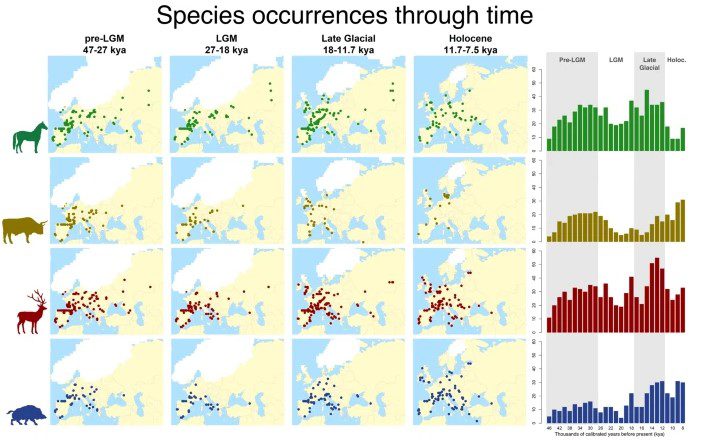
What happened to temperate ungulates in Europe during the climatic fluctuations that have affected the last 50,000 years? To answer this question we compiled a database of radiocarbon dates associated with remains of horses, aurochs, deer and wild boars dated between 47,000 and 7,500 years ago (so as to exclude domesticated individuals).
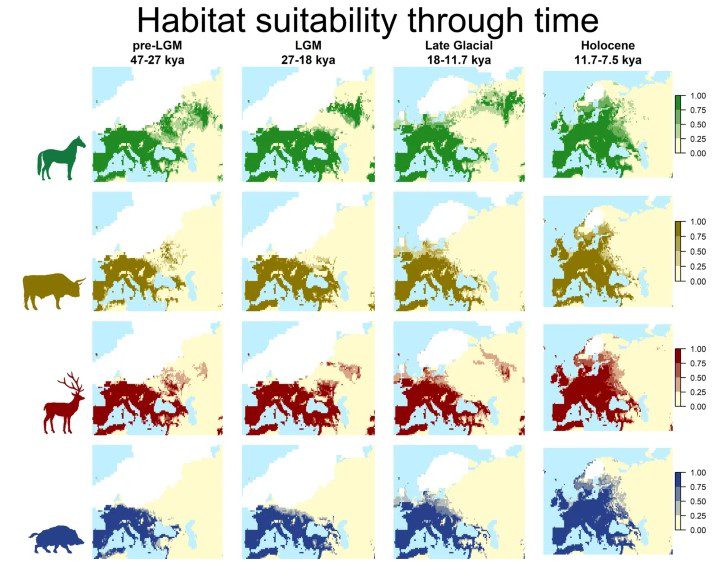
We then developed a new method to reconstruct their (realised) ecological niche, while also testing for changes through time.

Analysing our data we found that all four species changed their niche, mainly during the Last Glacial Maximum (LGM) or shortly after, in a pattern consistent with individual habitat preferences. The distribution of horses and deer (cold-adapted species) spread eastwards until the LGM, while aurochs and wild boar are restricted to Central and Western Europe. The four potential distributions became more similar from the LateGlacial (but it does not imply the same about their preferences).
In more general terms, with this study we demonstrate that even large species, with long generation times, can change their niche in the course of a few thousand years. This must suggest extreme caution when assuming that the ecological niche remains constant both when reconstructing the past and when forecasting the future.

And, if you got this far into this commentary, here is a little surprise for you!

Article

Michela Leonardi, Francesco Boschin, Paolo Boscato & Andrea Manica
Following the niche: the differential impact of the last glacial maximum on four European ungulates
Communications Biology volume 5, Article number: 1038 (2022) DOI: 10.1038/s42003-022-03993-7

Abstract

Predicting the effects of future global changes on species requires a better understanding of the ecological niche dynamics in response to climate; the large climatic fluctuations of the last 50,000 years can be used as a natural experiment to that aim. Here we test whether the realized niche of horse, aurochs, red deer, and wild boar changed between 47,000 and 7500 years ago using paleoecological modelling over an extensive archaeological database. We show that they all changed their niche, with species-specific responses to climate fluctuations. We also suggest that they survived the climatic turnovers thanks to their flexibility and by expanding their niche in response to the extinction of competitors and predators. Irrespective of the mechanism behind such processes, the fact that species with long generation times can change their niche over thousands of years cautions against assuming it to stay constant both when reconstructing the past and predicting the future.

pastclim, an R package to easily access and use palaeoclimatic data

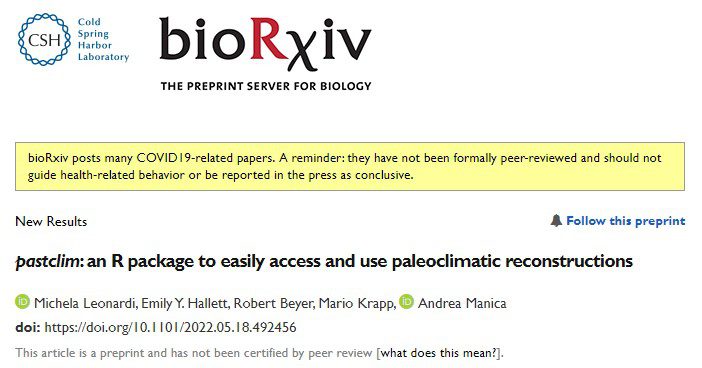
It is now out in bioRxiv a new preprint describing pastclim, an R package facilitating the access and the use of palaeoclimatic data, that I co-developed.

Michela Leonardi, Emily Y. Hallett, Robert Beyer, Mario Krapp, Andrea Manica
pastclim: an R package to easily access and use paleoclimatic reconstructions
bioRxiv 2022.05.18.492456; doi: https://doi.org/10.1101/2022.05.18.492456

Recently, the development of continuous palaeoclimatic reconstructions covering hundreds of thousands of years has made it possible to integrate the climate in the past into studies of many different disciplines: from paleoecology to linguistics, from archaeology to conservation biology, and from population genetics to human evolution.

Unfortunately, however, climate data can be difficult to extract and analyze for scholars unfamiliar with the specific formats in which it is shared. Together with my colleagues from Cambridge and Jena, we addressed this problem by creating pastclim: an R package that facilitates the access and use of two sets of paleoclimate reconstructions covering the last 120,000 and 800,000 years, respectively.

The package contains a set of functions that allow you to quickly and easily recover the climate of specific areas for periods of interest, extract climatic data of points scattered in space and/or time, recover historical series from single sites and easily manage perennial ice and coastlines.

The preprint contains two examples (the code in R and associated data can be downloaded from here). In the first one, we show how to extract the climate reconstructions for a single archaeological site with dated stratigraphic layers, i.e., in one location for multiple time slices. In the second one, we show how to analyse a larger number of sites with lower individual coverage, i.e., a number of points scattered in space and time.

More info:

website: https://evolecolgroup.github.io/pastclim/index.html
github: https://github.com/EvolEcolGroup/pastclim
vignette: https://evolecolgroup.github.io/pastclim/articles/a0_pastclim_overview.html

pastclim is not on CRAN.

[update 16/01/2023: pastclim is now on CRAN ]

Preprint

Michela Leonardi, Emily Y. Hallett, Robert Beyer, Mario Krapp, Andrea Manica
pastclim: an R package to easily access and use paleoclimatic reconstructions
bioRxiv 2022.05.18.492456; doi: https://doi.org/10.1101/2022.05.18.492456

Abstract

The recent development of continuous paleoclimatic reconstructions covering hundreds of thousands of years paved the way to a large number of studies from disciplines ranging from paleoecology to linguistics, from archaeology to conservation and from population genetics to human evolution. Unfortunately, such climatic data can be challenging to extract and analyze for scholars unfamiliar with such specific climatic file formats.

Here we present pastclim, an R package facilitating the access and use of two sets of paleoclimatic reconstructions covering respectively the last 120,000 and 800,000 years. The package contains a set of functions allowing to quickly and easily recover the climate for the whole world or specific areas for time periods of interest, extract data from locations scattered in space and/or time, retrieve time series from individual sites, and easily manage the ice or land coverage.

The package can easily be adapted to paleoclimatic reconstructions different from the ones already included, offering a handy platform to include the climate of the past into existing analyses and pipelines.

New project on Neanderthal palaeoecology

I am very honoured to announce that, starting from tomorrow, I will be working on a new Leverhulme-funded Research Project as the nominated researcher.

The project is called “Neanderthal Palaeoecology: the whens, hows, and whys of a species’ journey“, I co-wrote it together with my PI, prof. Andrea Manica, and it involves the collaboration with internationally renowned scholars (see the list at the end of the post).

Description

The following text is an extract of the article we wrote for the 2021 February’s Newsletter of the Leverhulme Trust (cover and page 16).

Neanderthals (Homo neanderthalensis) are a human species that lived in western Eurasia between approximately 350,000 and 30,000 years ago. Since the discovery of the first fossil in 1856, a huge body of research from multiple disciplines has helped us uncover more and more about this species.

Genetic analysis of DNA from fossil remains from multiple locations and periods has revealed a major population replacement between 90 and 120 thousand years ago in central Asia. Unfortunately, genetic data, which are very powerful at detecting change, cannot inform us of the processes behind such population dynamics. Climate is an obvious candidate in explaining this population turnover, but formally demonstrating its role is not easy.

We gathered an interdisciplinary team composed of archaeologists, ecologists, paleoclimate modellers and cultural evolution specialists. Together, we will investigate the role of climate in shaping the population dynamics of Neanderthals over their whole temporal and geographic range. We will also incorporate cultural information to see if and how different Neanderthal populations changed and adapted their behaviour in response to climatic fluctuations. 

By doing so, we will be able to put the population turnover that occurred 120 thousand years ago into context, providing a clear test of whether climatic changes are a likely explanation. But most importantly, for the first time, we will be able to test for the role of climate in the whole species’ journey of Neanderthals, integrating cultural evolution into the big picture, to better understand the whens, hows, and whys of the journey of this fascinating human species.

Stay tuned for exciting news and research outputs!

Collaborators

The project will be in collaboration with the following scholars (the order is the same in which they joined the project).

  • Prof. Katerina Harvati, University of Tuebingen;
  • Prof. Francesco D’Errico, University of Bordeaux;
  • Dr William E. Banks, University of Bordeaux;
  • Dr Judith Beier, University of Tuebingen;
  • Dr Philip Nigst, University of Vienna;
  • Dr Andrew Kandel, University of Tuebingen.
  • Zara Kanaeva, University of Tuebingen.

Climate and mountains shaped human ancestral genetic lineages

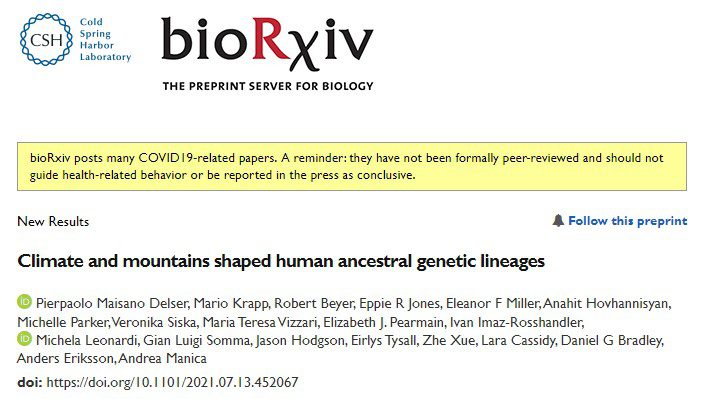
So excited to have contributed to this amazing new preprint!

In this study, we quantified the role of climate and mountains in shaping modern and ancient human genetic diversity.

Genomics shows that contemporary human populations result from the mixing of ancestral groups that are genetically distinct (ancestral genetic lineages) with unknown origins. In theory, ancient DNA could help disentangling their origin, but not in this case because we don’t have enough samples of the right age.

For this reason, we used a different strategy. We explicitly simulated the genetic history of humans in their spread out of Africa testing different values for demographic parameters and physiological responses to the changing climate. By doing so we could see if we can reconstruct the observed genetic diversity (spoiler alert: yes) and which parameters and climate variables shaped it.

For example, we find that aridity is the key factor controlling the timing for the out of Africa and mountains can be huge genetic barriers but only in some areas (e.g. Caucasus and Himalayas, not the Urals).

Thanks to this study, not only we could reconstruct such an important part of our genetic history, but we could also quantify the differential role of climate and topography through space and time in our spread out of Africa.

Preprint

Pierpaolo Maisano Delser, Mario Krapp, Robert Beyer, Eppie R Jones, Eleanor F Miller, Anahit Hovhannisyan, Michelle Parker, Veronika Siska, Maria Teresa Vizzari, Elizabeth J. Pearmain, Ivan Imaz-Rosshandler, Michela Leonardi, Gian Luigi Somma, Jason Hodgson, Eirlys Tysall, Zhe Xue, Lara Cassidy, Daniel G Bradley, Anders Eriksson, Andrea Manica
Climate and mountains shaped human ancestral genetic lineages
bioRxiv 2021.07.13.452067; doi: https://doi.org/10.1101/2021.07.13.452067

Abstract

Extensive sequencing of modern and ancient human genomes has revealed that contemporary populations can be explained as the result of recent mixing of a few distinct ancestral genetic lineages. But the small number of aDNA samples that predate the Last Glacial Maximum means that the origins of these lineages are not well understood. Here, we circumvent the limited sampling by modelling explicitly the effect of climatic changes and terrain on population demography and migrations through time and space, and show that these factors are sufficient to explain the divergence among ancestral lineages. Our reconstructions show that the sharp separation between African and Eurasian lineages is a consequence of only a few limited periods of connectivity through the arid Arabian peninsula, which acted as the gate out of the African continent. The subsequent spread across Eurasia was then mostly shaped by mountain ranges, and to a lesser extent deserts, leading to the split of Europeans and Asians, and the further diversification of these two groups. A high tolerance to cold climates allowed the persistence at high latitudes even during the Last Glacial Maximum, maintaining a pocket in Beringia that led to the later, rapid colonisation of the Americas. The advent of food production was associated with an increase in movement, but mountains and climate have been shown to still play a major role even in this latter period, affecting the mixing of the ancestral lineages that we have shown to be shaped by those two factors in the first place.